
The University of Osaka
Biological Anthropology Lab.

Our Reaseaches
Biological anthropology covers a wide range of research topics, from basic research to applied studies. It covers all evolutionary events that humans have encountered over the last 7 million years. This includes events that are currently happening to modern humans. Our laboratory is equipped with one of the world's largest experiment facilities of monkey motions, various high-speed cameras, large-scale motion capture devices, and digital morphological analysis systems, and we are exploring the origins and future of our behavior through a variety of research approaches, including observations and experiments on physical movements such as speech, walking, and manipulation, tissue dissection, comparative morphology, and numerical simulations. We are also conducting collaborative research with researchers both in Japan and abroad, making use of our laboratory's facilities, equipment, and network.
Recent Research Topics


Research Project
We are currently conducting research projects to elucidate the evolutionary process of human traits such as upright bipedal locomotion, manual dexterity, and language.


The beginning of culture and civilization
language
Language is what makes us human. The civilization and culture that we humans build by integrating various behavioral characteristics cannot evolve without language. Unfortunately, however, language does not become a fossil. There are human groups around the world that do not have written language, but there is no group that does not have spoken language. Human "spoken language" has many characteristics not found in other primates. In an effort to clarify the evolutionary process of the physical foundation that supports it, we are tackling the anatomy and movement of the speech organs through a combination of engineering experiments and numerical simulations.
JSPS科研費 基盤A (代表)
JSPS科研費 基盤B (分担)
JSPS科研費 基盤C (分担)
三菱財団 自然科学研究助成 (代表)


The beginning of human evolution
Bipedalism
With the acquisition of upright bipedal locomotion, human beings embarked on a unique evolutionary path. This brought about a major transformation of our bodies. We are conducting researches to clarify the sequence and factors that caused this largest transformation in human evolution. Our laboratory is equipped with one of the world's largest experiment facilities and cutting-edge analytical equipment of monkey motions. We also conduct monkey walking experiments in the field. Through various monkey experiments and comparisons, we continue to take on the challenge of elucidating the evolution of upright bipedal walking.
JSPS科研費 若手B (代表)
JSPS科研費 基盤B (分担)


The beginning of environmental change
Manipulation
Launching

An invitation to global distribution
Adaptation to climate
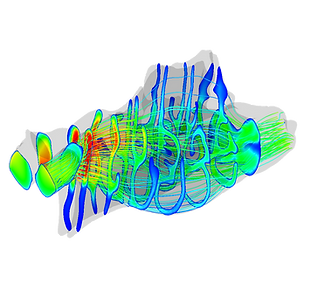
We humans have excellent vision but a poor olfactory sense. In the course of evolution, primates have made a trade-off between improved vision and a poorer olfactory sense. The nasal cavity, which is responsible for the olfactory sense, also has the function of regulating the temperature and humidity of the inhaled air. We are trying to understand the morphological adaptations of primates, including humans, by making full use of digital morphological analysis and numerical simulations.
